
Fluid Engineering
Research Area
Fluid Engineering
Turbulence, Flow Control and CFD / Bio-Mimetic Engineering Laboratory
Prof. Choi, Haecheon
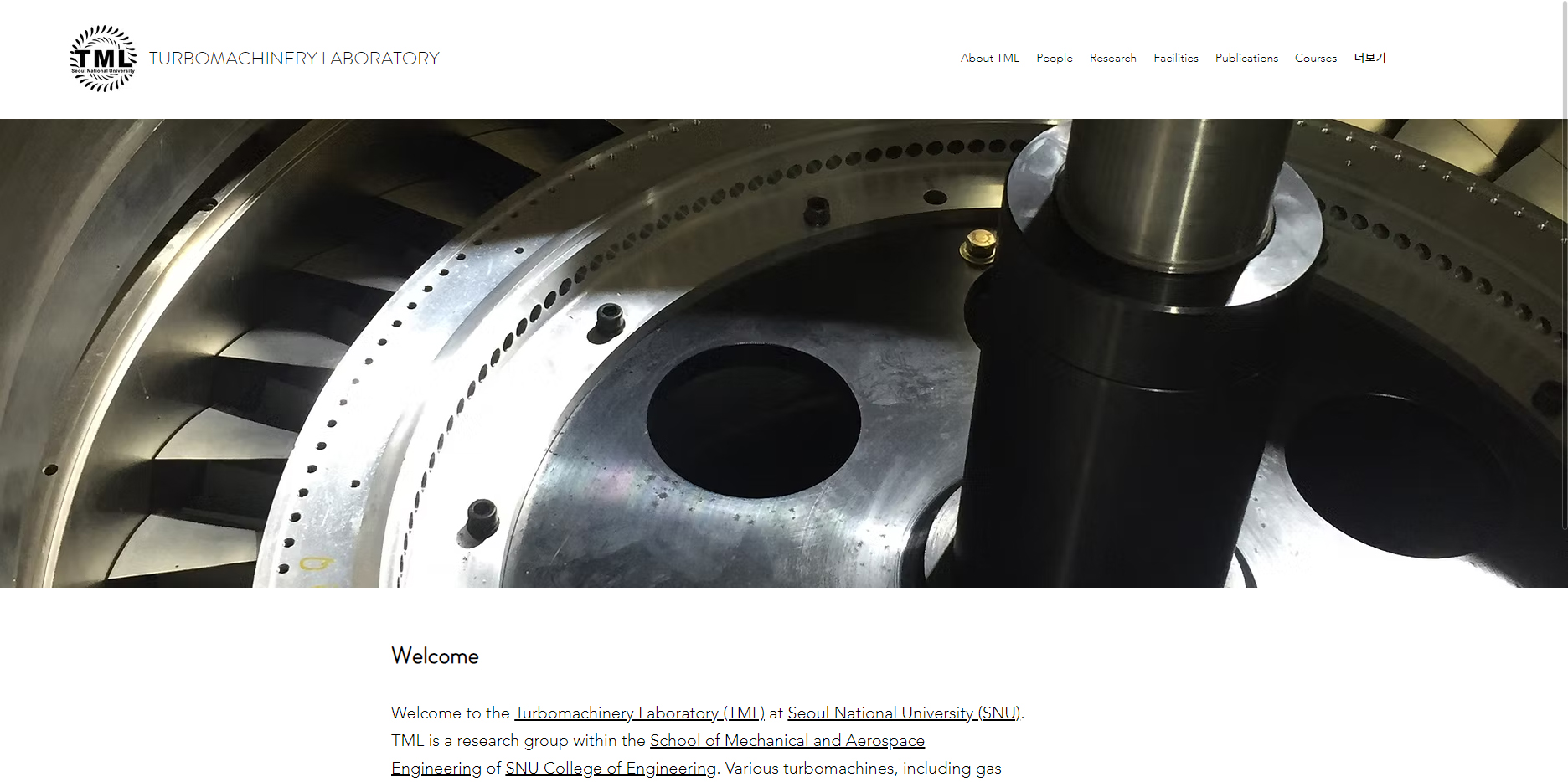
Turbomachinery Laboratory
Prof. Song, Seung Jin
The Turbomachinery Lab conducts research to enhance the aerodynamic performance and structural stability of various turbomachinery systems, including gas turbines.
The lab quantitatively analyzes complex flow phenomena such as fluid-structure interactions in high-speed rotors, cavitation, and rotational instabilities, aiming to improve the efficiency and reliability of propulsion and power generation systems.
Through close collaboration with industry partners, the lab develops practical energy solutions and explores next-generation turbomachinery technologies that support the transition to sustainable energy.

Microfluids & Soft Matter Laboratory
Prof. Kim, Ho-Young
The Microfluids & Soft Matter Lab aims to quantitatively understand and control the physical behavior of various soft materials, including microfluids, biofluids, gels, and shells.
By integrating ultrafast imaging, theoretical modeling, and numerical simulations, the lab investigates dynamic phenomena occurring in both manufacturing processes and everyday contexts.
Based on these insights, the lab develops innovative bio-inspired mechanical systems, soft robots, and nanoscale manufacturing techniques.
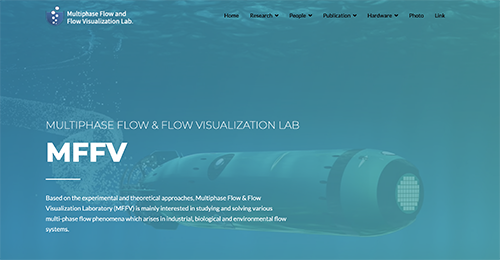
Multiphase Flow and Flow Visualization Laboratory
Prof. Park, Hyungmin
The Multiphase Flow and Flow Visualization Lab aims to quantitatively understand and address the physical mechanisms of complex multiphase flow phenomena occurring in industrial, biological, and environmental systems.
By combining advanced experimental techniques—such as high-speed imaging, Particle Image Velocimetry (PIV), and shadowgraphy—with numerical simulations, theoretical modeling, and machine learning algorithms, the lab investigates phenomena such as bubbly flows, particle-fluid interactions, and flow control on functional surfaces.
The lab also conducts experimental and theoretical studies in diverse applications, including the hydrodynamics of bio-inspired robots, droplet behavior in semiconductor cleaning processes, and particle dispersion in environmental flows, contributing to the design and control of next-generation fluid systems.
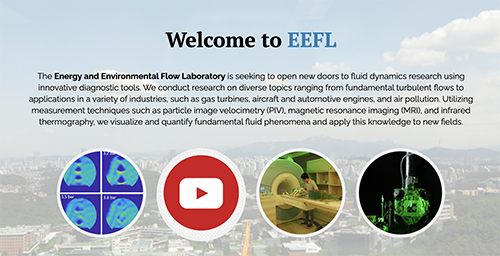
Energy & Environmental Flow Laboratory
Prof. Hwang, Wontae
The Energy & Environmental Flow Laboratory (EEFL) investigates the fundamental mechanisms of turbulent flows through advanced flow diagnostics, aiming to develop analysis and control technologies for industrial and environmental applications.
Using advanced measurement techniques such as Magnetic Resonance Velocimetry (MRV), Particle Image Velocimetry (PIV), and infrared thermography, they visualize and quantify complex flow phenomena including gas turbine blade cooling, aerospace and automotive engine flows, and airborne particulate dispersion.

Computer Aided Thermal Design Laboratory
Prof. Kim, Charn Jung
The Computer-Aided Thermal Design Lab conducts research using Multi-Scale Multi-Dimensional (MSMD) modeling techniques to predict the performance and lifespan of lithium-ion batteries (LIBs) and to develop micro/CFD analysis models for efficient simulation of solid oxide fuel cells (SOFCs).
The lab focuses on the precise analysis of thermal and fluid flow behavior in various energy systems, including fuel cells and batteries, with the goal of advancing performance-driven design and optimization technologies.
Advanced Energy System Laboratory
Prof. Song, Han Ho

Reacting Flow Laboratory
Prof. Do, Hyungrok
The Reacting Flow Lab focuses on developing laser-based diagnostic techniques to quantitatively analyze combustion and flow phenomena under high-temperature and high-pressure conditions.
The lab applies advanced optical methods—such as Tunable Diode Laser Absorption Spectroscopy (TDLAS), Laser-Induced Breakdown Spectroscopy (LIBS), and Laser-Induced Plasma (LIP)—to non-invasively measure temperature, pressure, and chemical composition in extreme environments, including supersonic combustors and high-pressure flames.
These diagnostics enable us to investigate combustion instabilities and control high-speed flows, contributing to the development of next-generation propulsion and high-efficiency energy systems.
Thermal and Reactive Systems Design Laboratory
Prof. Kim, Suyong
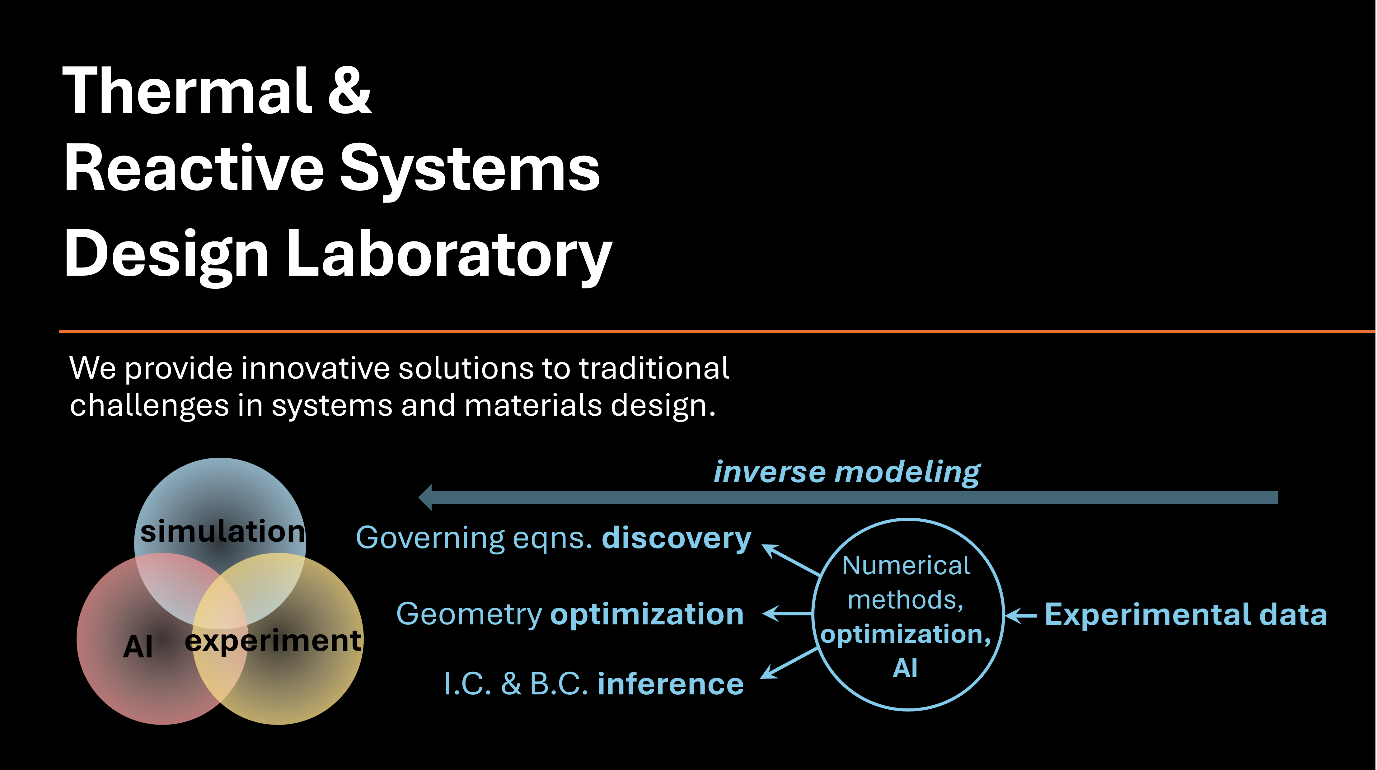
The Thermal and Reactive Systems Design Laboratory conducts research on the physical understanding and design technologies of systems where thermal transport and chemical reactions are coupled—such as energy conversion, propulsion, and thermal management systems.
Our lab aims to integrate experiments, simulations, and machine-learning methods to introduce new modeling approaches across these areas. Through this integration, we quantitatively elucidate physical phenomena that conventional analysis methods cannot capture, and we pursue a paradigm shift from empirically driven materials and system design to programmable performance design.
